physical therapy
Compliance prediction
needfinding & problem definition
As a part of my senior design capstone at Northwestern University, my team and I embarked on a year-long exploration of the disconnect between patients of physical therapy and their intended progress.
We identified physical therapy as a space for improvement through initial interviews with peers and common folk through our shared networks. However, it became clear quickly that reinventing physical therapy would not be a meaningful attempt at solving any particular issue.
As we interviewed dozens of patients and physical therapists, we identified a key shortfall of the process that left many patients and therapists frustrated and unmotivated. By asking where folks struggled, we found a sincere need for assistance in the process outside the studio or gym.
Essentially, most patients struggled with doing their exercises at home, a critically important part of the process as identified by therapists. Through conversations with therapists, we identified a critical issue: most conversations about at-home exercises focused on how patients felt when practicing, rather than what they did or how they did it.
Given the clear emphasis on encouragement from therapists, our team focused on measuring and validating patient compliance in real-time.
what is compliance?
-
Physical therapists interviews and medical research made clear the need for consistent exercising and stretching to optimize the recovery process. A core, simply measured metric focusing on the number of repetitions per set and the number of sets performed for a given exercise took shape quickly and clearly.
-
Emphasized heavily during our conversations with physical therapists, the quality of an exercise has far more impact on patient recovery than quantity. Measuring form was not a straightforward task, but it was clear from our patient interviews that many folks were nervous to exercise at home in fear of injuring themselves further.
-
Intensity was defined as a measure of effort, reflected by biofeedback monitors. Though it had a lower perceived impact on patient recovery, it gave us a more complete picture of what the patient's experience was. Intensity could be the signal in the noise for a number of things, including areas for improvement, potential noncompliance, and general health concerns.
validating compliance using biofeedback
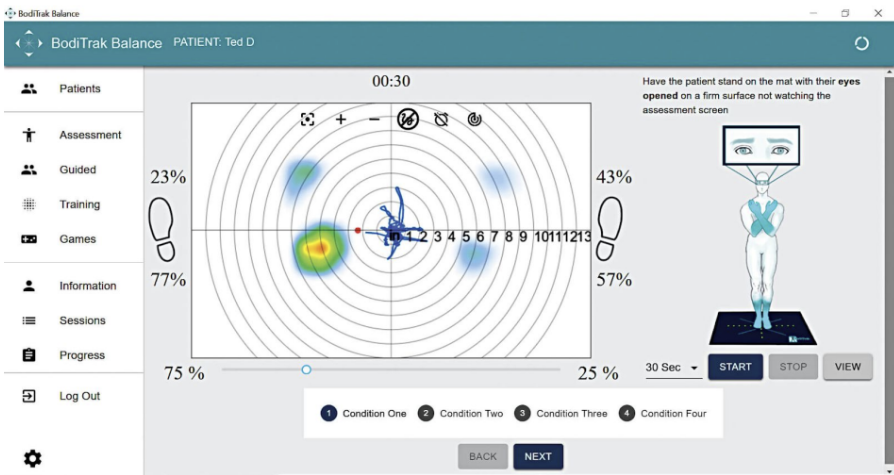
Balance and position, as measured by the BodiTrak Balance mat, tracked a patient’s movements during their exercises. With two outputs, our team measured the center of pressure during an exercise as a function of time and distance. This allowed our team to quantify the weight distribution across an exercise for an individual using proper form.
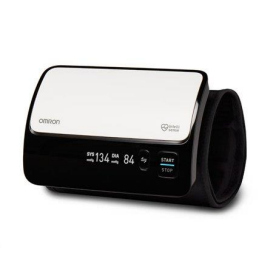
OMRON Digital Blood Pressure CuffBodiTrak Balance Assessment SystemBlood oxygenation (SpO2) and heart rate, as measured by the Lookee Wrist Sleep Monitor, approximated the level of effort or intensity during a given session. This device gave continuous discrete results, taken every 4 seconds. Through data validation, blood oxygenation proved to be the key metric for intensity, as heart rate was too varied (non-normal distribution) throughout a session.
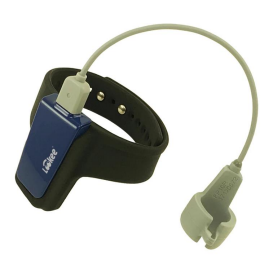
Lookee Wrist Sleep MonitorBlood pressure, as measured by the OMRON digital blood pressure cuff, was used to quantify frequency. The intention was to show demonstrate that the increase in blood pressure corresponded directly with the level of effort by patients when exercising. However, thorough statistical analysis (along with data scaling complications across variables) proved that blood pressure did not have a statistically significant correlation with exercises, whether done correctly or not, as it was not measured during exercises.
OMRON Evolv Bluetooth Wireless Upper Arm Blood Pressure Monitor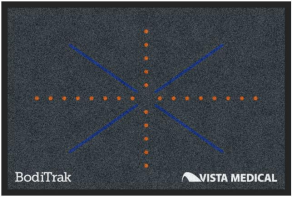
methods of noncompliance
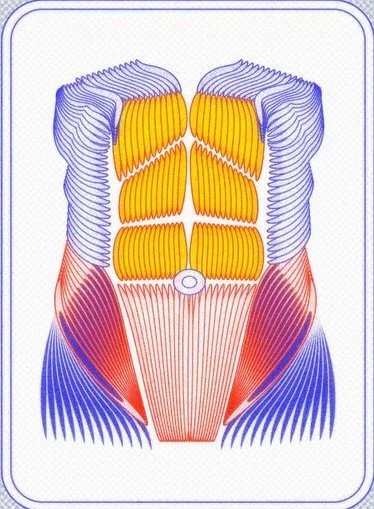
01 Core engagement
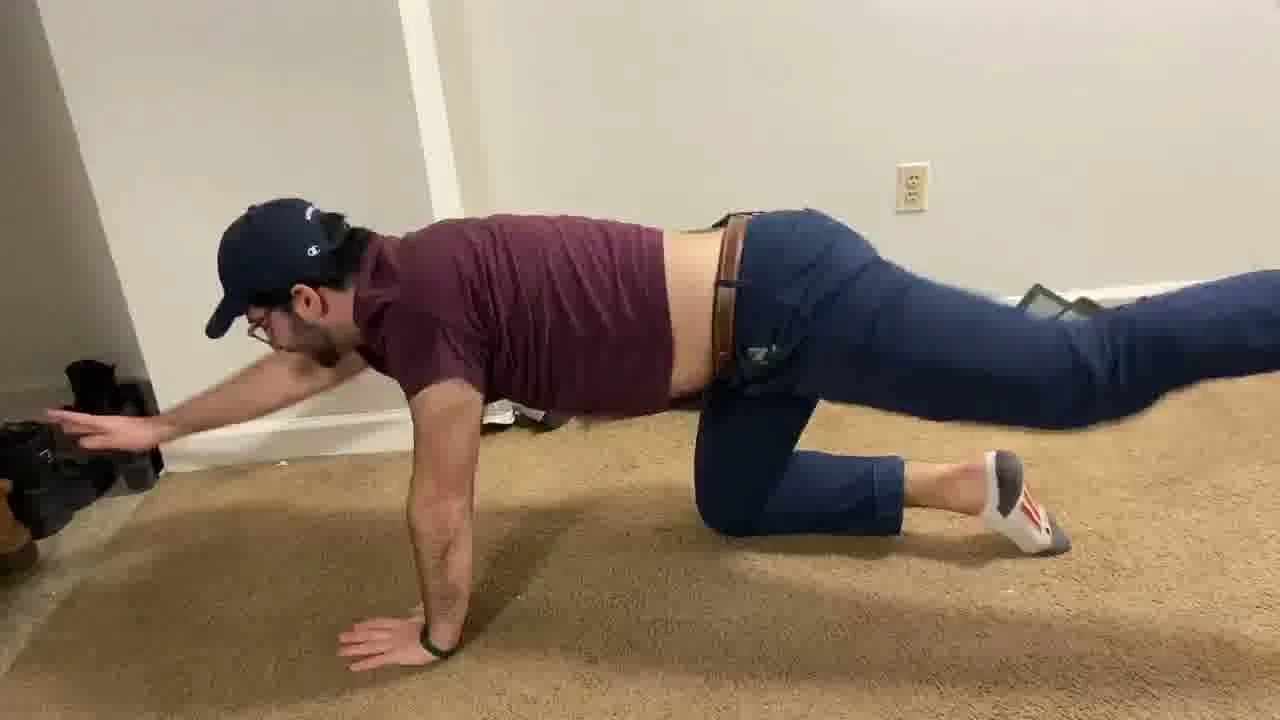
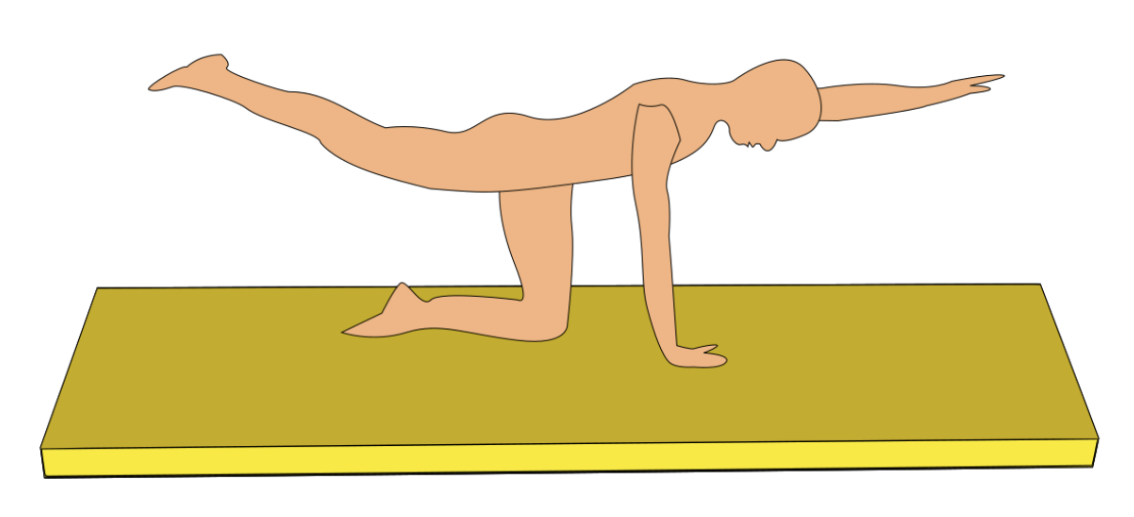
A lack of core engagement leads to improper engagement of the muscle chain and poor balance during bird dog. This is an extremely common form issue that can lead to reinjury or entirely new problems.
03 loss of balance
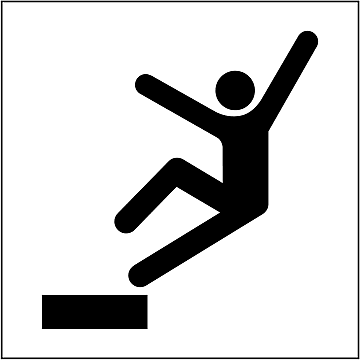
The most extreme method of noncompliance, falling introduces sincere risk for patients. The uncontrolled movement and resulting impact from the fall can injure patients or worsen existing conditions.
Full extension of limbs is necessary to stretch the targeted areas and get the most out of the exercises.
02 limb exteNSION
testing protocol
measure baseline biometrics
1
In a seated, relaxed position, measure blood pressure, blood oxygenation, and heart rate at rest. Record measurements in a spreadsheet for future analysis.
perform compliant bird dog
2
Using bird dog as a standard exercise, get on the BodiTrak mat and begin recording. With perfect form (to the best of one’s ability), perform 10 repetitions of bird dog, at about 3 seconds per rep. Approved compliant methods include engaged core, full limb extension, muscle chain engagement
record elevated biometrics
3
Immediately after finishing the session, measure all biofeedback again and record the time. Save recorded blood pressure, heart rate, and blood oxygenation. Rest for 15 minutes to return to baseline.
perform noncompliant bird dog
4
Get on the BodiTrak mat and begin recording. With intentionally poor form, perform 10 repetitions of bird dog, at about 3 seconds per rep. Approved noncompliant methods are limited to unengaged core, partial limb extension, and loss of balance (falling).
record elevated biometrics
5
Immediately after finishing the session, measure all biofeedback again and record the time. Save recorded blood pressure, heart rate, and blood oxygenation. Rest for 15 minutes to return to baseline.
data analysis
To accurately predict a compliant session from the data, the mat data proved invaluable. The mat output was X-Y coordinates over time of the center of pressure on the mat, as shown to the right. The raw data was transformed into the following variables:
R — measured in inches, radial distance from the global origin
θ — measured in degrees, polar angle of point from global origin
Distance — measured in inches, localized distance between current and immediately previous center of pressure
Compliant Session
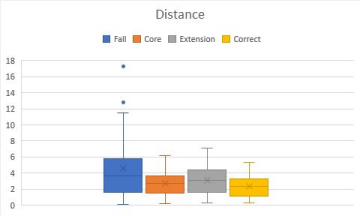
Using unpaired, equal variance t-tests for the normally distributed variables (excluding biofeedback) showed that the best metric for accurately predicting compliance is distance. This is because our distance value measured not where a patient moved, but how. When distance values were smaller, it showed a slower, controlled movement more common among compliant sessions.
nonCompliance type lack of balance
The best variable for predicting a patient fall as the type of noncompliance is distance. The t-tests showed minimal differences for fall sessions against the compliant control sessions for all variables but distance, which had a p-value of .000639, meaning it could be an extremely effective predictor. However, this is likely due to the maximum range values of distance for falls. Since the fall is entirely uncontrolled, the distances vary widely, as the center of pressure jumps around the map. These outliers somewhat skew the overall distance data population, but serve as a clear marker. Using this data, one can assume that an optimal solution to checking for a loss of balance relies on checking maximum distance values (uncontrolled movements) beyond a certain level.
nonCompliance type Core
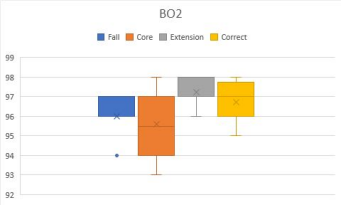
The best variable for predicting an unengaged core as the specific type of noncompliance is also distance (kind of). The t-test showed minimal differences for unengaged core sessions against the compliant control sessions for all variables. However, distance had a p-value of .074, which was closest to the desired .05 value that determines statistical significance. Given the explanation above regarding muscle control, this theory of using distance holds some weight. Since no mat variable was significant, the biofeedback criteria were brough back in. As can be seen clearly from the blood oxygenation boxplot to the right, an unengaged core session produced significantly lower readings, including a mean outside the lower bounds of every other session type. Using this data, it can be theorized that an optimal solution to checking for an unengaged core relies on checking maximum distance values (uncontrolled movements) and minimum blood oxygenation values (lack of muscle engagement).
nonCompliance type incomplete extension
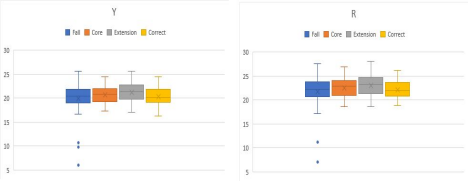
The best variables for predicting incomplete limb extension as the specific type of noncompliance are Y and R. These variables, in essence, represent the global distance between the origin and the center of pressure at a given time, measured in two different ways. Y represents the raw Y-coordinate output from the mat, whereas R is a polar measurement of the distance as function of both X and Y. The t-test showed p-values of .021 for Y and .020 for R. These statistically significant results ensure that both variables can be effective predictors of this type of noncompliance. In a real world sense, it is understood that incomplete limb extensions will center the pressure closer to the origin. This will also ensure that the range of values for Y and R will not be as wide as a normal, compliant session. Therefore, an optimal solution to checking for incomplete limb extension relies on checking the range of Y and R values (minimal movement).